

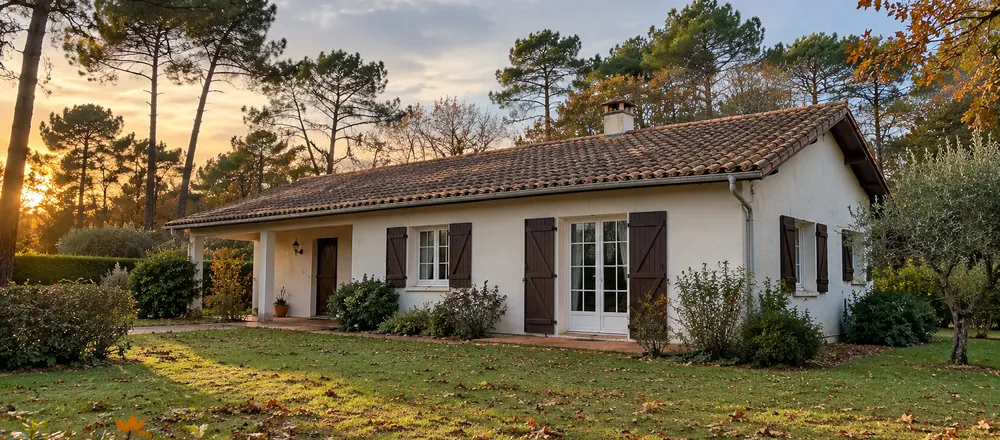
On 1 January 2027, the factor that converts electricity into primary energy in the DPE, France's energy performance certificate, falls from 1.9 to 1.7. An electrically heated house can move up a class without any work, and no longer require an energy audit if it moves from E to D. If you are selling an E, F or G rated house in Mont-de-Marsan, Saint-Pierre-du-Mont, Dax or Saint-Sever, here is how to tell whether it is affected and whether it is better to sign before or after that date.
Not sure which case your house falls into? Send me your DPE number, printed at the top of the report: in a first conversation, with no obligation, I will tell you what the January change could mean for your sale.
What changes in the DPE on 1 January 2027
The diagnostic de performance énergétique (DPE) rates a home from A to G according to its primary energy consumption and its greenhouse gas emissions. For electricity, consumption is converted into primary energy using a factor. This factor fell from 2.3 to 1.9 on 1 January 2026. The order of 19 August 2026, published in the Journal officiel on 26 August (new tab), lowers it to 1.7 from 1 January 2027.
For a home that runs entirely on electricity, the consumption used by the DPE therefore falls by around 10.5%. According to the impact assessment of the text, quoted by the consumer association UFC-Que Choisir in August 2026, around 300,000 main residences will leave classes F and G on that date. The ministry states that no home will see its rating get worse.
You have nothing to redo. DPEs and audits carried out up to 31 December 2026 remain valid. From 1 January 2027, they can be updated free of charge and immediately on the website of ADEME's Observatoire DPE-Audit (new tab), without a new visit from the assessor: the certificate you obtain replaces the rating on the original DPE.
Will your electrically heated house move up a class?
It depends on the consumption shown on your DPE and on the factor used to calculate it: 2.3 for a DPE carried out between July 2021 and December 2025, 1.9 for a DPE carried out in 2026 or updated with the 2026 certificate. For a house where everything is electric, heating and hot water included, here are the values up to which it will reach at least the class shown from 1 January 2027.
| Class reached in 2027 | DPE calculated with 1.9 (2026) | DPE calculated with 2.3 (2021–2025) |
|---|---|---|
| D or better | up to 279 | up to 338 |
| E or better | up to 368 | up to 446 |
| F or better | up to 469 | up to 568 |
Example: an all-electric house whose 2026 DPE shows 360 kWh/m²/year is rated F. With the 1.7 factor, its consumption falls to around 322 kWh/m²/year, which is class E, without any work.
These values are calculation benchmarks, based on the DPE thresholds, not a diagnosis. The class retained is still the worse of the two ratings, energy and climate; for an all-electric home, it is in practice the energy rating that decides. Homes under 40 m² have adjusted thresholds. If your house is heated with wood, gas or oil, only the electric share of consumption is recalculated: the gain is small. Only the ADEME certificate is authoritative.
Sell before or after 1 January 2027?
The DPE and, where required, the energy audit are annexed to the preliminary sale agreement (compromis or promesse de vente). An agreement signed in December 2026 therefore carries the rating in force on that date: the certificate based on the 1.7 factor can only be obtained from 1 January 2027.
| Your situation | What 1 January 2027 changes | Option to consider |
|---|---|---|
| Electrically heated house rated E, F or G, below one of the thresholds in the previous table | It moves up at least one class; if it moves from E to D, the audit is no longer required | Prepare the sale now and aim for an agreement signed after 1 January |
| Electrically heated house above these thresholds | Its consumption falls, but it stays in the same class | No reason to wait on this ground alone |
| House heated with wood, gas or oil | Rating changes little or not at all | Sell on your own timetable, with the audit if it is rated E, F or G |
| Flat in a co-ownership building (copropriété) | The rating may improve if heating is electric | No audit, whatever the class: the timetable does not depend on it |
| DPE carried out before 1 July 2021 | It has no longer been valid since 1 January 2025 | Have a new DPE carried out before publishing the listing; it can be updated by certificate in January |
A property listing must show the DPE class. If your house moves up a class in January, the listing and the sale file are updated with the certificate: I take care of this for the houses I have a mandate to sell, from the first listing to the signing at the notary's office. The full selling process is set out on the page selling your house in the Landes, and illustrated in the article on selling a house in Saint-Pierre-du-Mont.
The right moment also depends on the market in your town and on how long a sale takes. During the free valuation of your house, I go through actual local sale prices, your DPE and the signing date to aim for with you.
Mandatory energy audit: which houses are affected?
Since 1 April 2023 for classes F and G, and since 1 January 2025 for class E, selling a house (maison individuelle) or a building in single ownership requires a regulatory energy audit (audit énergétique) in addition to the DPE. The obligation will extend to class D on 1 January 2034. Flats in co-ownership buildings are not subject to it. The details of the obligation are set out in the ministry's questions and answers on the regulatory energy audit (new tab). For a flat, the valuation method is explained in the article on valuing a flat in Mont-de-Marsan.
The audit is carried out by an approved professional, paid for by the seller, and handed to the buyer from the first viewing. It is valid for five years. It sets out renovation scenarios, with an estimate of their cost, to improve the home's performance; the buyer is not obliged to carry them out. Audit prices are not regulated: compare several quotes. The other diagnostics needed to sell a house in the Landes, including the termite and risk reports, are covered in the article diagnostics for selling a house in the Landes.
The audit also benefits from the 1.7 factor: an audit carried out in 2026 can be updated by certificate in 2027. And because the obligation covers classes E, F and G, an all-electric house rated E that moves to D on 1 January 2027 is no longer subject to the audit for an agreement signed after that date.
How much does a poor DPE cost when selling in the Landes?
Notaires de France measure the price gap linked to the energy rating every year, for comparable properties. According to their study on the green value of homes, published in December 2025 on 2024 sales (new tab), a house in Nouvelle-Aquitaine rated E sold for around 11% less than a comparable house rated D. The gap reaches around 23% for a house rated F and 32% for a house rated G. It is one of the regions where the gap is widest: on average in France, it is 18% for an F house and 25% for a G house.
To put these percentages in context, here are the median house prices in the four towns I cover, calculated from actual 2025 sales, all ratings combined.
| Town | Median price per m² | House sales |
|---|---|---|
| Mont-de-Marsan | €2,012/m² (new tab) | 277 |
| Saint-Pierre-du-Mont | €2,221/m² (new tab) | 83 |
| Dax | €2,466/m² (new tab) | 146 |
| Saint-Sever | €1,456/m² (new tab) | 66 |
In August 2026, the latest complete annual DVF dataset available is for 2025. The median prices above cover transactions recorded from 1 January to 31 December 2025; they describe completed sales, not an instantaneous market price in 2026.
DVF, the sales database published by the French tax authority (DGFiP), does not record the DPE of the properties sold: these figures cannot be used to calculate a discount specific to each town. The notaries' percentages are regional averages; the value of a given house is established from comparable local sales and a viewing. Town-by-town benchmarks are on the pages devoted to the Mont-de-Marsan property market, the Saint-Pierre-du-Mont property market, the Dax property market and the Saint-Sever property market, and I explain how to read these medians in the article on Mont-de-Marsan property prices in 2026.
Which works to do before selling an E, F or G rated house?
Renovation carried out just before a sale is not necessarily reflected in the price: the buyer has their own project, and the audit already gives them costed scenarios. Three steps come first, and cost almost nothing:
- Check that your DPE is still valid: a DPE drawn up before 1 July 2021 no longer is. The DPE validity rules (new tab) are set out on Service-Public.fr, the French government's information site.
- Gather the invoices for insulation, window or heating work: without supporting documents, the assessor may have to use default values, which are often less favourable.
- If your house is electrically heated, download the January 2027 certificate before ordering work intended only to gain a class.
For a larger project, the ministry states that under the new calculation, replacing a gas or oil boiler with a heat pump gives a bigger gain in rating. Grants change often: the public service France Rénov' (new tab) provides free information on those currently available.
For a house that needs renovating, I can also draw plans of the existing property and a 3D projection of a renovation scenario, so that buyers can picture the property's potential. This is a separate service from the valuation and the sale mandate, on quotation: plans and renovation projections before a sale. I am a building draughtswoman; I am not registered with the French Order of Architects.
Buyers and investors: can an F-rated house still be let?
As of 1 November 2026, the Climate and Resilience Act (loi Climat et résilience) has prohibited letting a G-rated home under a new lease since 1 January 2025. The ban will extend to homes rated F on 1 January 2028, then to homes rated E on 1 January 2034. Rents for F and G homes are frozen.
The 1.7 factor changes the picture for some electrically heated houses: a house that moves from F to E on 1 January 2027 can still be let after 2028 under the current rules.
The bill on the revival and decentralisation of housing (new tab) (projet de loi relance et décentralisation du logement), adopted by the Senate on 8 July 2026, would allow F and G homes to be let again in return for a commitment to carry out work. The economic affairs committee of the National Assembly adopted it on 22 September 2026, but as of 1 November 2026 it has not been finally passed: until it is, the current bans apply.
If you are looking for a house to renovate in the area, the DPE and the audit are part of what I review with you before any offer, under a property search mandate in Mont-de-Marsan, Dax and the Landes. For a purchase in Dax, the checks specific to the town are set out in the article on buying property in Dax in 2026. I work with buyers in French, English and Spanish.
