

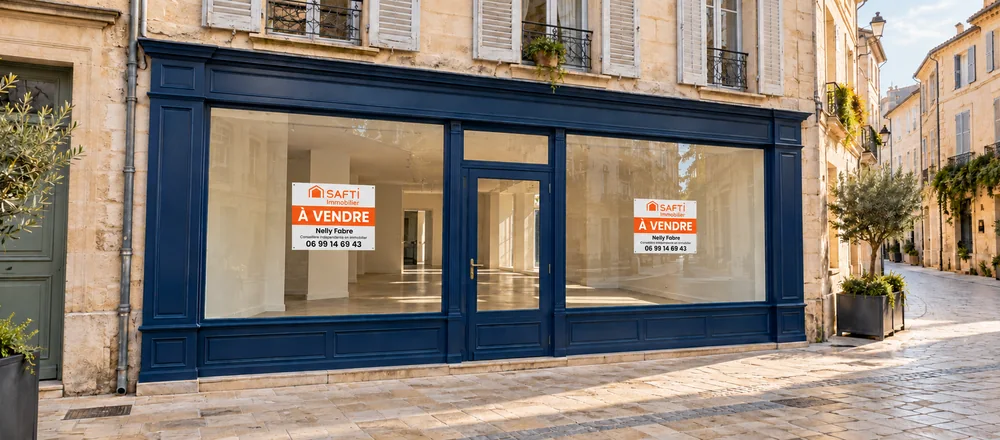
An empty commercial unit can be sold as it is, to a trader or an investor, or turned into a home. Conversion depends first on the local development plan and, in a shared building, on the co-ownership rules; the type of works then decides between a prior declaration and a building permit. Here is how to decide in Mont-de-Marsan, and what the sales recorded in 2025 show.
What 2025 sales of commercial premises show
The French land registry sales database (DVF, Demandes de valeurs foncières), published by the tax authority (DGFiP), files these properties under "industrial, commercial or similar premises". The category mixes shops, offices, workshops and warehouses: it is far more varied than the housing categories.
In Mont-de-Marsan, DVF records 32 sales of premises in this category in 2025. That is too few, and too varied, to publish a reliable median price: I don't publish one.
Beyond volume, the value of a unit depends on criteria a median ignores: location, length of shop frontage, condition, and whether or not a lease is in place.
Once converted, the property is compared with the housing market. In Mont-de-Marsan, the 2025 DVF median for flats stands at €2,141/m² across 213 sales; other benchmarks are gathered on the page dedicated to the Mont-de-Marsan property market. This comparison only makes sense once the works have been costed: the price of a finished home says nothing about the cost of getting there.
In August 2026, the latest complete annual DVF dataset available is for 2025. The median prices above cover transactions recorded from 1 January to 31 December 2025; they describe completed sales, not an instantaneous market price in 2026.
Selling as it is: what changes if the unit is let
A unit sold free of any lease leaves the buyer free to choose their project: run a business there, let it or convert it. A let unit is sold with its commercial lease, which the buyer takes over.
In the second case, the tenant has a right of first refusal (droit de préférence, article L145-46-1 of the French Commercial Code). The owner must notify the tenant of the price and terms of the sale, by registered letter with acknowledgement of receipt or by hand delivery against a receipt; this notice counts as an offer to sell. The tenant has one month to reply. If they accept, the sale must be completed within two months, or within four months if they take out a loan.
If the owner later considers selling at a lower price or on more favourable terms, they must first notify this new offer to the tenant, who again has one month. The right of first refusal does not apply in certain cases, notably the sale of a whole building containing commercial units, or a sale to the owner's spouse, parent or child. Failing to follow this procedure exposes the sale to being challenged. Since 28 May 2026, offices and warehouses have been explicitly excluded from the scope of this right.
For the sale file, plan at least for the risk report (état des risques), the energy performance assessment (DPE) and, if the building permit predates 1 July 1997, an asbestos survey.
Converting into a home: four checks before any quote
1. The local development plan
Turning a shop into a home is a change of designated use (changement de destination) under the French Planning Code. The local development plan (PLU) can regulate it, or even prohibit it in certain streets: it can mark out streets where commercial diversity must be preserved (article L151-16 of the Planning Code).
Mont-de-Marsan has been part of the Action cœur de ville programme since 2018, which is dedicated to revitalising town centres. Before anything else, check the rules that apply to your plot, on the Géoportail de l'urbanisme or with the town hall's planning department.
2. The co-ownership rules
If the unit is part of a co-owned building (copropriété), the co-ownership rules set the designated use of each lot and of the building. They may reserve a lot for commercial use, or restrict the activities allowed. A conversion they do not permit requires amending them through a vote at the general meeting.
3. Planning permission
A change of designated use without altering the load-bearing structure or the façade requires a prior declaration (déclaration préalable, article R421-17 of the Planning Code). If it comes with works that alter the load-bearing structure or the façade, a building permit is required (article R421-14). Replacing a shop window with standard windows alters the façade: a point to anticipate for any ground-floor shop unit.
The processing time is in principle one month for a prior declaration, and two or three months for a building permit depending on the project, longer in a protected area (article R423-23).
For a building permit, using an architect is mandatory if the applicant is a company, such as a property company (SCI), whatever the floor area (article L431-3). An individual is exempt as long as the floor area does not exceed 150 m² (article R431-2).
4. The rules for a home that will be let
To be let, the new home must meet decent housing standards: at least one main room of 9 m² with a ceiling height of 2.20 m, or a living volume of 20 m³, and sufficient natural light (decree no. 2002-120 of 30 January 2002). It must also comply with the energy timetable: since 1 January 2025, a home rated G can no longer be let in mainland France, and homes rated F will follow on 1 January 2028.
The Denormandie scheme also covers converting premises used for another purpose into a home. Mont-de-Marsan is one of the Action cœur de ville towns, one of the conditions for the scheme. Works must amount to at least 25% of the total cost of the operation, and the scheme is open until 31 December 2027; whether the town is covered can be checked on the official Service-Public simulator. The other conditions of the project still need to be checked.
Sell or convert: how to decide
The two options are not always mutually exclusive. Four questions help you choose:
- Do the PLU and, where relevant, the co-ownership rules allow a home at this location? If the answer is no, the question is settled.
- Will the works affect the façade or the load-bearing structure? That is what separates a prior declaration from a building permit, and sometimes decides whether an architect is required.
- Do you have the time and budget for building works? Planning approval, works, then letting or selling: conversion is measured in months.
- Is the unit let? A commercial lease in place protects the tenant: converting first requires the lease to end, and refusing its renewal in principle entitles the tenant to eviction compensation (indemnité d'éviction, article L145-14 of the Commercial Code).
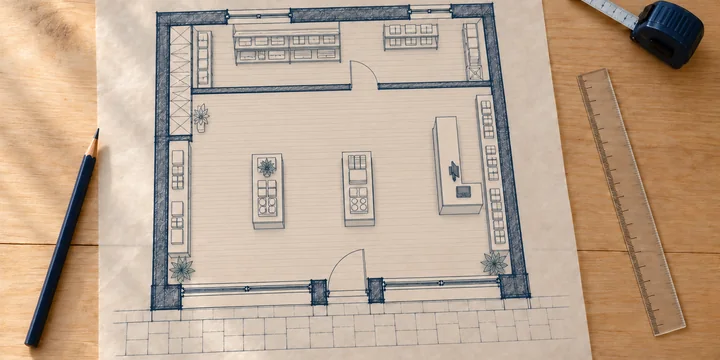
Selling as it is with layout plans helps a buyer picture the conversion, without you taking on the works.
How I support this kind of project
I can handle the sale of commercial premises, a unit or a leasehold right (droit au bail) under a mandate with the SAFTI network; the fees are then paid by the buyer, according to the network's scale of fees. Before marketing, I review with you the existing lease, the unit's position under the PLU and the surveys to gather.
If you are considering conversion, I can draw the layout plans for the future home: this is a separate service, quoted on request, never included in the mandate (Home design & plans). I am a building draughtswoman; I am not registered with the French Order of Architects. Where the law requires an architect, notably for an SCI or above 150 m², an architect draws up the architectural project for the permit. I do not carry out structural calculations or project management.
Sources
- DVF land registry sales data, DGFiP — Mont-de-Marsan town file, 2025 data.
- French Planning Code (Code de l'urbanisme) — articles L151-16, R421-14, R421-17, R423-23, L431-3 and R431-2.
- French Commercial Code (Code de commerce) — articles L145-46-1 (tenant's right of first refusal) and L145-14 (eviction compensation).
- Decree no. 2002-120 of 30 January 2002 on the characteristics of decent housing.
- Service-Public — timetable banning lets of energy-inefficient homes (in French).
- Service-Public — Action cœur de ville and Denormandie simulator (in French).
- Géoportail de l'urbanisme (in French).
- French Ministry for Territorial Cohesion — Action cœur de ville press kit, 27 March 2018.
- SAFTI network — scale of fees, version of 1 January 2026.
